Home/Products/Shaped Wire/Shaped Wire Materials
Shaped Wire Materials
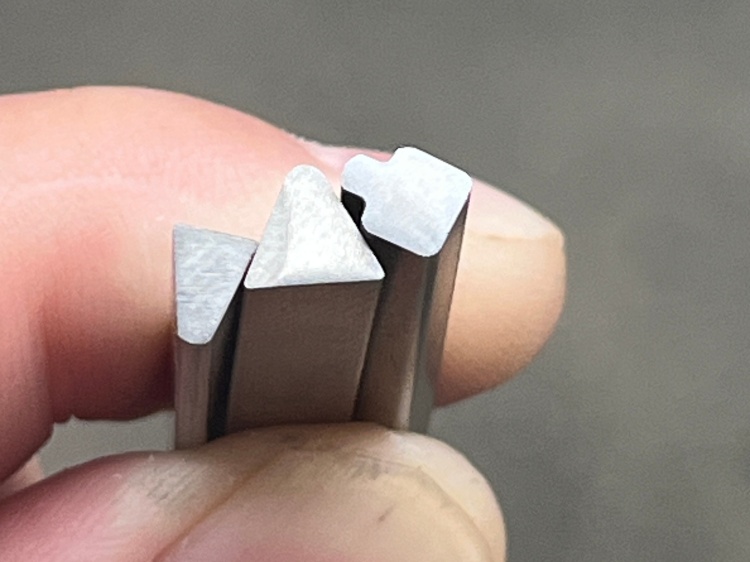
Shaped Wire Materials
| Material | Q235,304,316,2507 |
|---|---|
| Size range | 0.5*15 |
| Typical application | Industrial parts |
| Cross-section | Square — also drawn to your drawing |
| Surface | Bright drawn, as required |
| Packing | Coil, spool or straight length |
Shaped Wire Materials: Picking the Alloy That Actually Survives
A shaped wire profile can be perfect on the drawing and still fail in the field — usually because the alloy was wrong for what it touches. The cross-section does the mechanical work, but the material decides whether the part survives salt, heat, acid, or just a damp environment. Specifying the metal is at least half the job.
Here's how we pick materials at ERQI Wire, and what each one is actually good for.
The materials we draw most
| Material | What it handles | Best for |
|---|---|---|
| 304 stainless | Indoor corrosion, food, architecture | General parts, mesh, decorative |
| 316L stainless | Chlorides, marine, chemical | Seawater screens, chemical service |
| 301 / 302 (spring) | High strength after work hardening | Clips, springs, retaining rings |
| Carbon & alloy steel | Load, cost, not corrosion | Structural, dry-environment parts |
| Duplex | Strength + corrosion together | Oil & gas, aggressive service |
| Inconel / nickel | Heat, oxidation, harsh chemicals | High-temp, chemical processing |
| Monel | Seawater, no chloride attack | Marine, saltwater components |
Why 304 usually isn't enough
304 is the default stainless for a reason — it's affordable and shrugs off most indoor corrosion. But the moment a part sees chlorides, 304 pitting starts, and once it starts it doesn't stop. We see it constantly in coastal or chemical environments: a 304 screen or mesh that looked fine for a year, then fails where 316L would have kept going.
316L earns its higher price through molybdenum, which is what resists pitting in chloride service. If the wire goes near seawater, de-icing salt, or process chemicals, 316L isn't an upgrade — it's the floor.
When it has to spring back
For clips, springs, and retaining rings, the material has to return to shape after deflection. That's where 301 and 302 come in: austenitic grades that work-harden hard during drawing and forming, so a thin section carries real spring load. The catch is they work-harden during our own process too, which is why annealing between passes matters more on these grades — the wire has to stay formable until the last draw.
Carbon and alloy steel: cheap, strong, thirsty
If corrosion isn't in the picture, carbon steel is the value play — high strength, low cost, easy to draw. Alloy steel pushes strength or hardness further for demanding loads. The trade is rust: a carbon steel profile left in a damp environment is a brown profile inside a month. Coating or plating can buy time, but for anything wet, stainless wins on total cost.
The exotic end
Duplex, Inconel, and Monel are the materials we reach for when the environment is genuinely hostile. Duplex gives you roughly double the strength of 304 with comparable corrosion resistance — useful where a thinner profile has to carry more load. Inconel stays strong and oxidation-resistant well past where stainless has given up, so it's the call for high-temperature or aggressive chemical service. Monel shrugs off seawater and chloride in a way even 316L doesn't, which is why it shows up in marine hardware.
These aren't everyday choices, but when a part sits in saltwater or acid, the alloy is the only thing between you and a failure.
Material changes how we draw it
The alloy isn't just a spec line — it changes the process. Stainless and nickel grades work-harden faster, so they need more annealing passes. Harder materials hold a sharper corner but are less forgiving on die wear. Carbon steel draws easily but surface rust can start before the wire is even spooled if it isn't handled right.
So material choice feeds straight back into tolerance and lead time, not just cost.
FAQ
Which material for outdoor or marine use? 316L stainless at minimum; Monel if it's continuously in seawater.
Can you combine a custom profile with an exotic alloy? Yes — we draw duplex, Inconel, and Monel to customer profiles routinely. Send the drawing and the service condition.
Does material affect minimum order? Exotic alloys usually carry a higher minimum and longer lead time than 304/316L, simply because the stock isn't sitting on the shelf.
How do I know if 304 is enough? If the part stays dry and indoors, 304 is fine. If it sees moisture, salt, or chemicals — step up to 316L.
If you're specifying a profile and aren't sure the alloy will survive the environment, send the drawing and the service condition. We'll tell you whether 304 will do, or whether you're better on 316L, duplex, or something further up the ladder.
Related products
Ready to start your project?
Send us your drawing or sample — we reply within 24 hours on working days.