If you work with shaped wire—also called profile wire or special-shaped wire—you have probably run into this: the same bare wire, made into a different cross section or from a different material, can vary wildly in how hard it is to produce. With round wire you can often just run one drawing line from start to finish. Try that with a shaped section and the wire either will not pull, or the tooling is wrecked after a couple of passes.
In real production, the more irregular the shape, the harder the material, and the tighter the tolerance, the less you can force everything through one process. The industry relies on four methods for the vast majority of work: die drawing, roll drawing, rolling, and combined rolling-and-drawing. Below each one is broken down by principle, strengths, and pitfalls so you can pick the right route for your product.
Principle. A drawing machine pulls the wire straight through a die whose opening is the inverse of the target cross section. The wire enters one side and exits already shaped—essentially the same idea as round-wire drawing, only the die carries a shaped profile instead of a circle.
Typical process. Coil rod → surface preparation (pickling / coating + lubricant) → pointing (tapering the tip) → multi-pass progressive drawing (each die slightly smaller and nearer the final shape) → sizing → straightening or coiling.
Die material. For heavier wire, cemented carbide (YG-class); for fine wire, PCD polycrystalline diamond or natural diamond; high-speed steel is also used where volume and durability justify it.
Pros. Good dimensional accuracy and surface finish, especially for small sections and tight tolerances; dies are relatively cheap and quick to set up, so short trial runs are economical; the process is mature and handles flat, square, rectangular, and simple custom sections.
Cons / pitfalls. The die is worn by direct abrasion, so hard, gritty, or abrasive materials can destroy it fast; each pass has a limited reduction (generally 15%–25%), so big shape changes need many passes; work-hardening materials like stainless steel must be annealed every few passes or they seize or break; complex shaped dies are expensive and slow to make.
Best for. Precision small sections, tight tolerances, and high surface requirements—stainless flat wire, square wire, rectangular wire, and simple custom profiles.
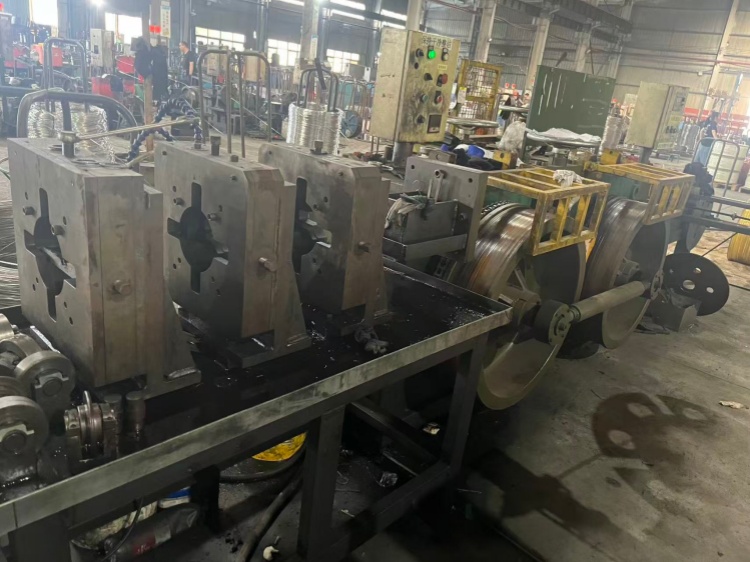
Principle. Replace the fixed die in a drawing line with a set of profiled rolls. The wire is pulled through the roll gap and the rolls turn with it, "rolling" the shape out as they spin. It is still fundamentally drawing, but the forming tool is a rotating roll instead of a stationary die.
Pros (vs die drawing). The rolls rotate, so wear spreads over the whole circumference and tool life is far longer than a fixed die—and a worn roll can be reground; per-tool cost is lower, and hard or difficult materials are less likely to destroy the tooling; rolling friction means less heat and drag, so single-pass reduction can exceed die drawing and line speed can be higher; residual stress in the wire is lower, which is friendlier to difficult materials like stainless steel.
Cons / pitfalls. For some extremely complex or ultra-precision shapes, accuracy is slightly below a fixed die; roll profiles are geometrically limited and cannot form the most awkward sections; setup is a bit more involved than swapping a die.
Best for. Large reductions, hard materials, high volume, or anywhere die drawing keeps wrecking dies. Many high-volume flat and rectangular wires are cheaper on rolls than on dies.
Principle. Die and roll drawing are both "pulled"; rolling is "fed." The mill rolls are powered and actively bite the wire into the gap, reducing and forming it. Shaped grooves cut into two or more rolls press a round wire or billet directly into the target section.
Common equipment. Two-roll mills, three-roll mills, four-roll heads (such as the Turkish-head / Turk's Head four-roll arrangement), and purpose-built tandem multi-roll mills for specific products.
Process. Usually cold rolling (sometimes warm or hot); the billet is progressively flattened and formed in grooved rolls, with annealing between passes as the deformation demands.
Pros. Large single-pass reduction and high efficiency for volume work; high material utilization with essentially no chips; the grain flow follows the shape after rolling, giving good mechanical properties; "wide-and-thin" sections like flat and rectangular wire are far easier on a mill than on a draw bench.
Cons / pitfalls. Roll tooling is expensive and setup is lengthy, so small batches are uneconomic; very small or strongly asymmetrical sections are hard to control, and springback and tolerance need watching; large deformation requires intermediate annealing or the material cracks.
Best for. Flat wire, rectangular wire, high volume, and large reductions; it is also often used to pre-form a billet close to shape before a die-drawing finish pass.
Principle. Roll and draw in one line—first use rolls to take a billet roughly to shape with big reductions, then use die drawing to finish (locking dimensions and surface). The two can also alternate.
Pros. The large reduction of rolling plus the high accuracy of drawing, each covering the other's weakness; complex shapes and difficult materials become feasible, with good flexibility; fewer drawing passes and fewer anneals, saving process steps.
Cons / pitfalls. A longer line with more equipment means higher investment; the processes must be matched to each other—it is not simply bolting two machines together.
Best for. Complex custom sections, difficult materials, and "tough jobs" that need both tight tolerance and a complicated shape.
| If you need… | Choose |
|---|---|
| Small section, tight tolerance, good surface | Die drawing |
| Hard material, high volume, dies keep failing | Roll drawing |
| Flat / rectangular, large reduction, high volume | Rolling |
| Complex shape, difficult material, still need precision | Combined rolling & drawing |
Two more reminders. First, material drives the process: stainless steel work-hardens hard, so anneal between passes; copper and aluminum are soft and easy to form, but watch springback and surface. Second, the tighter the tolerance and the stranger the shape, the more you should consider combined rolling-drawing or a die-drawing finish pass—do not start by forcing a single method.
The four most common are die drawing, roll drawing, rolling (cold rolling), and combined rolling-and-drawing. Together they cover the overwhelming majority of shaped wire production.
Both pull the wire through a shaped opening. Die drawing uses a stationary profiled die; roll drawing uses rotating profiled rolls. Rolls last longer, handle harder materials better, and allow larger single-pass reductions, while fixed dies give marginally higher accuracy on the most demanding shapes.
Rolling suits flat and rectangular sections, large reductions, and high-volume runs. It is also commonly used to pre-form a billet close to shape before a finishing draw.
Yes. Stainless is widely used, but its strong work hardening means intermediate annealing between passes. Die drawing, roll drawing, rolling, and combined processes can all be applied depending on the section and tolerance.
The target cross section, material grade, required tolerance, order quantity, and whether a drawing or sample is available. These decide which of the four routes—or a combination—is most economical.
There is no single "correct" process for shaped wire; shape, material, tolerance, and volume together decide the route. Die drawing is closest to round-wire work and quick to start; roll drawing is durable and cheaper on hard materials; rolling is efficient for large reductions and high volume; combined rolling-drawing is flexible and built for complex, difficult jobs. Master these four and you can match well over 90% of shaped wire production scenarios.
This article is prepared by the technical team at Hubei ERQI New Materials Co., Ltd. We specialize in stainless shaped wire and profile wire—triangular, wedge, flat, square, rectangular, and fully custom sections—in materials including 304, 316L, and 2205 duplex, made to your drawing and tolerance. We can support die drawing, roll drawing, rolling, and combined processes.
Related products:
Email: info@erqiwire.com · Website: erqiwire.com — send us your drawing or sample to discuss a suitable production solution.
Contact: Kevin
Phone: +8613669008985
Whatsapp:+8613669008985
Email: info@erqiwire.com
Address: Xiangyang, Hubei Province, China
Web:erqiwire.com