Home/Products/Wedge Wire/Wedge Wire for Mining Screens
Wedge Wire for Mining Screens
Wedge wire panels built for abrasive duty: heavier V-profile, closer support bar spacing and duplex options. The open area is set by the slot and the bar spacing, not by a drilling pattern that wears open.
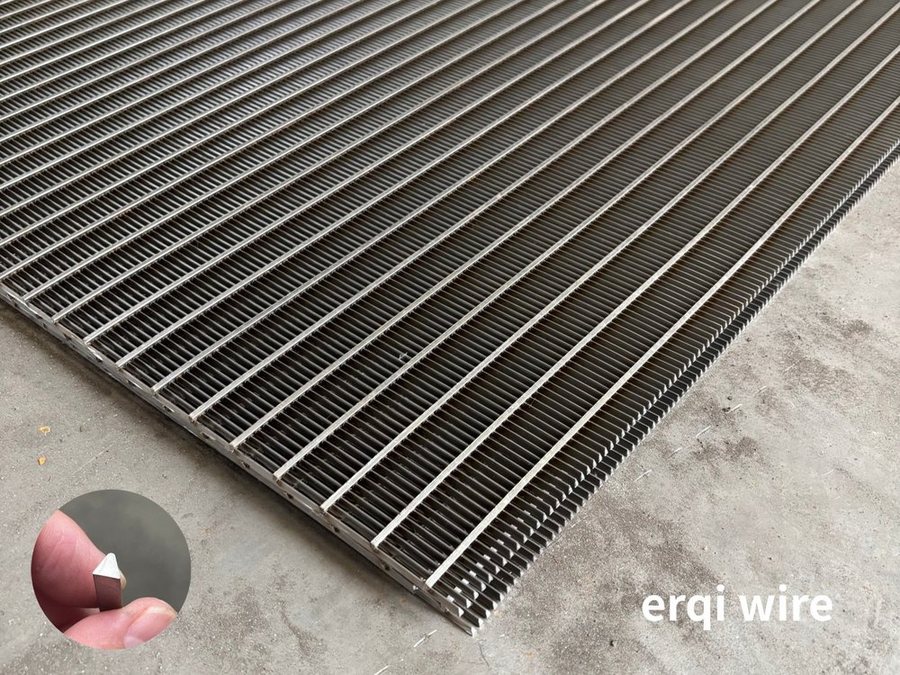
Wedge Wire for Mining Screens
Wedge wire panels built for abrasive duty: heavier V-profile, closer support bar spacing and duplex options. The open area is set by the slot and the bar spacing, not by a drilling pattern that wears open.
| Material | 304 / 316L stainless steel, 2205 duplex, wear-resistant grades on request |
|---|---|
| Size range | Slot 0.3-3.0 mm, panel up to 1500 x 3000 mm, support bar spacing 100-300 mm, profile 3x5 to 6x10 mm |
| Typical application | Vibrating screens, sieve bends, dewatering and desliming decks, trommel panels, coal and ore sizing |
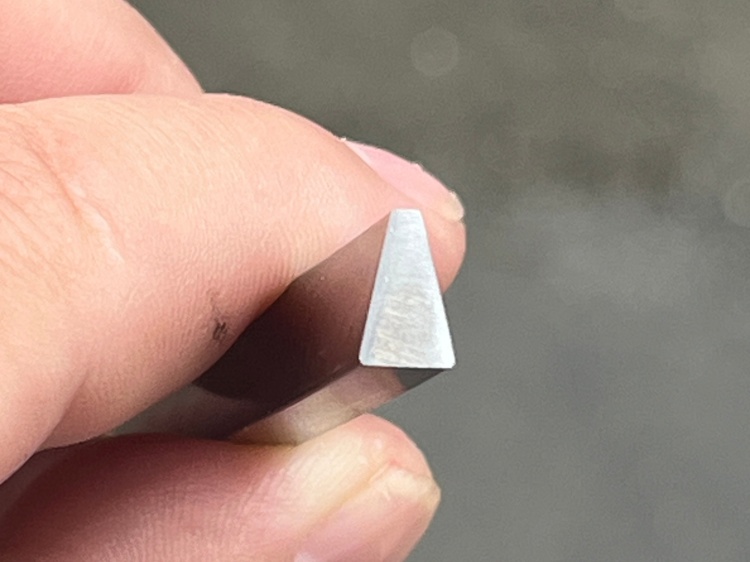
| Cross-section | Square — also drawn to your drawing |
| Surface | Bright drawn, as required |
| Packing | Coil, spool or straight length |
Mining is the hardest duty a wedge wire screen meets: abrasive ore, impact from a dropping load, and a slurry that carries both. The construction does not change — V-profile wire welded across support bars — but three numbers get heavier, and they are what separates a mining panel from a dewatering panel.
What mining duty changes
The profile gets bigger. A dewatering deck might use 2.5×4 mm V-wire. An ore screen handling 200 mm lumps uses 6×10 mm or heavier, because the wire has to survive impact as well as set a slot. A heavier profile also stands proud of the panel, so the slot keeps working as the surface wears.
The support bars get closer. On a static deck, support bar spacing of 300 mm is common. On a vibrating screen it is often 100–200 mm, because the panel is being accelerated thousands of times an hour and the wire between bars is what flexes. Closer bars mean less flex, longer fatigue life, and a stiffer panel under load.
The slot gets wider. Mining slots run 0.3–3.0 mm, wider than filtration, because the job is sizing rather than clarifying. Wide slots also mean the open area is dominated by bar spacing rather than by slot width — a point worth checking before a panel is ordered.
Open area: where mining panels are won and lost
Open area is the fraction of the panel surface that is hole. For wedge wire it comes from two things: slot width divided by wire pitch across the wires, multiplied by the fraction of length not blocked by support bars. A panel with 1 mm slots on a 3 mm pitch has 33 % open across the wraps; if support bars occupy 8 % of the length, the effective figure is about 30 %.
That is why a mining panel with slightly wider support bar spacing can outperform one with better wire: throughput follows open area, and open area follows bar spacing until stiffness becomes the limit. Our support bar page has the arithmetic laid out.
Wedge wire vs polyurethane vs punched plate
Polyurethane wins on wear in fine sizing and is quiet, but it blinds with wet sticky feed and its apertures wear round, which changes the cut point. Punched plate is cheap and stiff but has a fixed hole pattern and a flat surface that peens over under impact, closing holes. Wedge wire is the middle case: metal wear resistance, a slot that cannot close because it is formed by a gap rather than a hole, and a surface that sheds rather than holds moisture.
Where wedge wire is clearly right: dewatering and desliming decks, sieve bends, trommel panels, and anything with a wet feed that blinds polyurethane. Where polyurethane usually wins: dry fine sizing with high abrasion and no blinding problem.
Material choice
304 for coal and non-corrosive ore. 316L for chloride-bearing process water and marine terminals. 2205 duplex where abrasion and chloride arrive together — it holds up better than 316L under both, at a price that only pays on long campaigns. Wear-resistant grades are available on request for extreme duty.
Specifications
| Slot | 0.3–3.0 mm |
|---|---|
| Profile wire | 3×5 mm to 6×10 mm V-profile, heavier on request |
| Support bars | 4–10 mm, spacing 100–300 mm by duty |
| Panel size | Up to 1500 × 3000 mm; cut to your deck drawing |
| Material | 304 / 316L stainless, 2205 duplex, wear-resistant grades |
| Fixing | Bolted, clamped or hooked to the deck frame; edge profiles on request |
| Surface | Pickled and passivated |
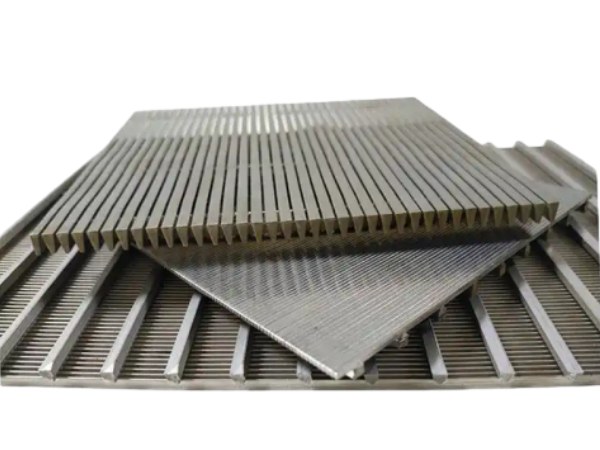
Panel construction and generic deck use are on the wedge wire screen panel page; the wire itself is covered under wedge wire. Send the deck drawing, the feed size and the tonnage — profile, bar spacing and slot are chosen together.
Related products
Ready to start your project?
Send us your drawing or sample — we reply within 24 hours on working days.