Home/Products/Wedge Wire/Duplex Wedge Wire 2205 & 2507
Duplex Wedge Wire 2205 & 2507
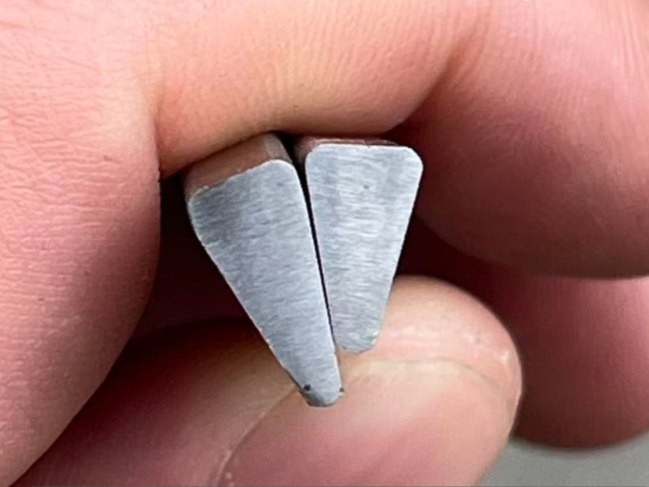
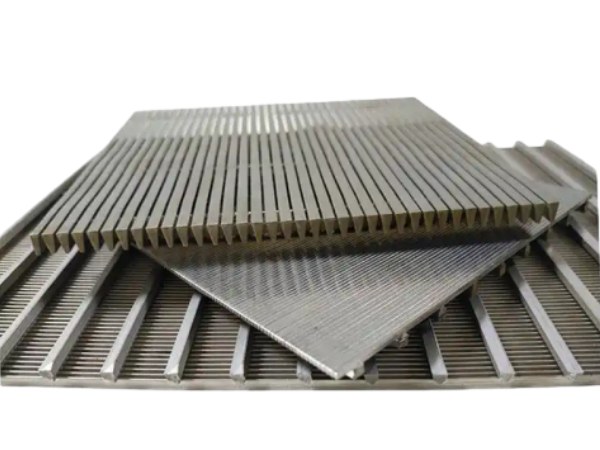
V-profile wedge wire drawn in 2205 and 2507 duplex, solution annealed after drawing so the wire keeps its corrosion resistance. Roughly 2.5 times the yield of 316L, at a PREN of 35 or 43.
Duplex Wedge Wire 2205 & 2507
V-profile wedge wire drawn in 2205 and 2507 duplex, solution annealed after drawing so the wire keeps its corrosion resistance. Roughly 2.5 times the yield of 316L, at a PREN of 35 or 43.
| Material | 2205 duplex (UNS S32205) / 2507 super duplex (UNS S32750) |
|---|---|
| Size range | Profile 1.5x2.5 to 6x10 mm, slot 0.10-3.0 mm, OD 25-300 mm or flat panels; solution annealed after drawing |
| Typical application | Desalination intakes, offshore produced water, brine and chloride duty, chemical process screening, coastal intake screens |
| Cross-section | Square — also drawn to your drawing |
| Surface | Bright drawn, as required |
| Packing | Coil, spool or straight length |
Duplex stainless gets specified on a wedge wire screen for one of two reasons: the screen has to carry a load that 316L cannot, or the process water carries chloride at a temperature where 316L stress-corrodes. Both are routine in desalination, offshore produced water and chemical process screening. What is not routine is a duplex screen whose wire was actually solution annealed after drawing — and that omission does not show up on a price sheet.
Why duplex belongs on a screen at all
Strength buys open area. 2205 yields at roughly 450–485 MPa against about 190 MPa for 316L. On a screen, that strength goes into the support bars and the wire itself: thinner bars at the same deflection, or wider bar spacing at the same stiffness. Wider spacing means more open area at the same slot, which is throughput for free.
Chloride stress corrosion is the other reason. 316L under tensile load in warm chloride water cracks; the threshold is low enough that coastal and brine duty sits right on it. Duplex holds far past that point, and 2507 further still.
It wears better than 316L too. Higher hardness and a two-phase microstructure mean abrasion from sand and scale does less to the slot edges. It is not a wear alloy — for dry abrasive duty the high-manganese grades do more per dollar — but where corrosion and moderate abrasion arrive together, duplex handles both without a compromise.
PREN: the number that separates 2205 from 2507
Pitting resistance equivalent number, PREN = %Cr + 3.3×%Mo + 16×%N. It is a ranking, not a guarantee, but it is the fastest way to compare two alloys on chloride duty.
| Grade | Typical composition | PREN | Yield |
|---|---|---|---|
| 316L | 17 Cr, 12 Ni, 2.5 Mo | ~25 | ~190 MPa |
| 2205 | 22 Cr, 5.5 Ni, 3 Mo, 0.15 N | ~35 | ~450 MPa |
| 2507 | 25 Cr, 7 Ni, 4 Mo, 0.28 N | ~43 | ~550 MPa |
The eight-point gap between 2205 and 2507 is not cosmetic. It is the difference between a screen that survives warm seawater and one that pits at the weld within a season. In practice: 2205 for chloride water up to roughly 60 °C and moderate concentration; 2507 for hotter brine, higher chloride, or where seawater sits stagnant against the surface between cycles.
The step almost nobody quotes: annealing after drawing
Cold drawing a V-profile puts a large amount of energy into the wire. In duplex steel that energy shows up as deformation-induced martensite in the austenite phase, a dislocation density several orders above the annealed state, and a phase balance that has drifted away from 50/50. The wire gets harder and stronger, which looks like a benefit on a datasheet, and less corrosion resistant, which does not show until the screen is in service.
Restoring it means a solution anneal at 1020–1100 °C followed by a water quench, then a pickling pass to remove the oxide. That is a second furnace cycle per coil, and it is the reason a properly made duplex wire costs more than a drawn-and-shipped one.
Three things to ask a supplier, in this order: was the wire solution annealed after the final draw, what ferrite/austenite ratio came out of the test, and is there a corrosion test report rather than only a chemistry certificate. A wire that was never annealed will still pass a chemistry check — it is the same heat — while failing a pitting test in chloride.
Welding duplex wedge wire
Filler is ER2209 for 2205 and ER2594 for 2507. Heat input stays in the 0.5–2.5 kJ/mm band, interpass temperature stays under 150 °C, and there is no preheat. The weld and its heat-affected zone should test at 35–65 % ferrite: too little ferrite and the zone cracks under restraint, too much and it loses toughness and corrosion resistance. On a screen, the weld is a spot between V-wire and support bar made hundreds of times per panel, so the parameter has to be held by the machine, not by the operator's mood.
What duplex is not for
Hydrochloric acid, hydrofluoric acid, and hot concentrated sulphuric acid attack the ferrite phase first — that is C276 territory, covered on the C276 wedge wire page. Dry abrasive ore with no chloride is better served by a high-manganese alloy, which costs a fraction of duplex for the same wear life. And a screen that never sees chloride is paying for corrosion resistance it will not use.
Configurations
The alloy is available in every construction we build: cylindrical screens and laterals, flat panels, sieve bends, and the loose V-profile wire on its own. The screen laterals and wedge wire pages cover the geometries; the support bar material page covers what has to match.
Specifications
| Grades | 2205 (S32205/S31803), 2507 (S32750); 2304 on request |
|---|---|
| Profile wire | 1.5×2.5 mm to 6×10 mm V-profile, drawn and solution annealed |
| Slot | 0.10–3.0 mm, measured across the outside face |
| Forms | Cylinders OD 25–300 mm, flat panels to 1500×3000 mm, sieve bends, loose wire |
| Support bars | 3–8 mm, same grade as the wire |
| Heat treatment | Solution anneal 1020–1100 °C + water quench after final draw |
| Surface | Pickled and passivated |
Send the medium, the chloride level and the temperature — those three decide whether 2205 is enough or the job needs 2507, and that decision is worth more than any discount on the wire.
Related products
Ready to start your project?
Send us your drawing or sample — we reply within 24 hours on working days.