Home/Products/Wedge Wire/Wedge Wire Panels for Pressure Screens
Wedge Wire Panels for Pressure Screens
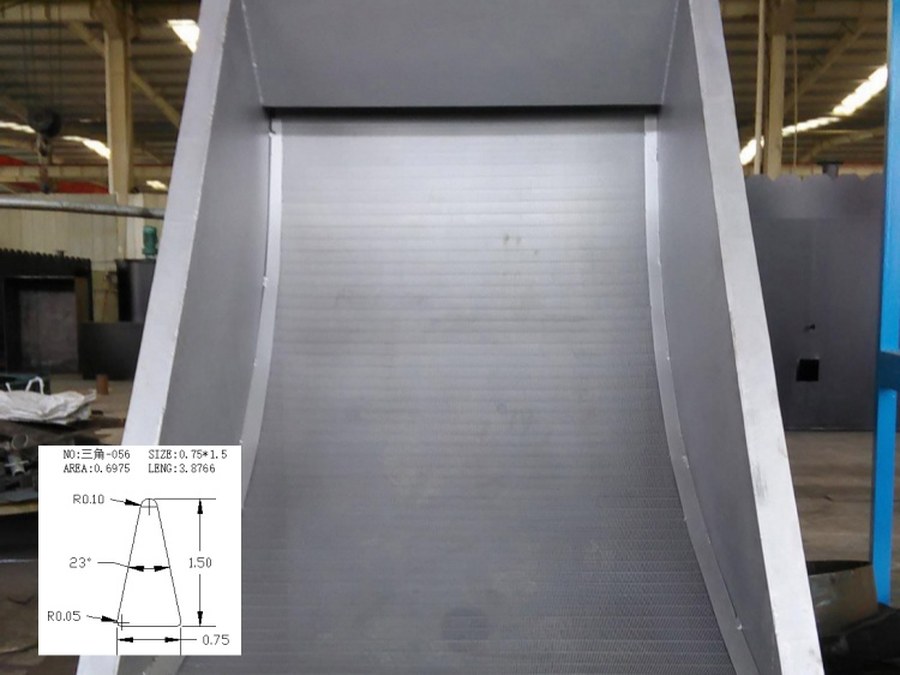
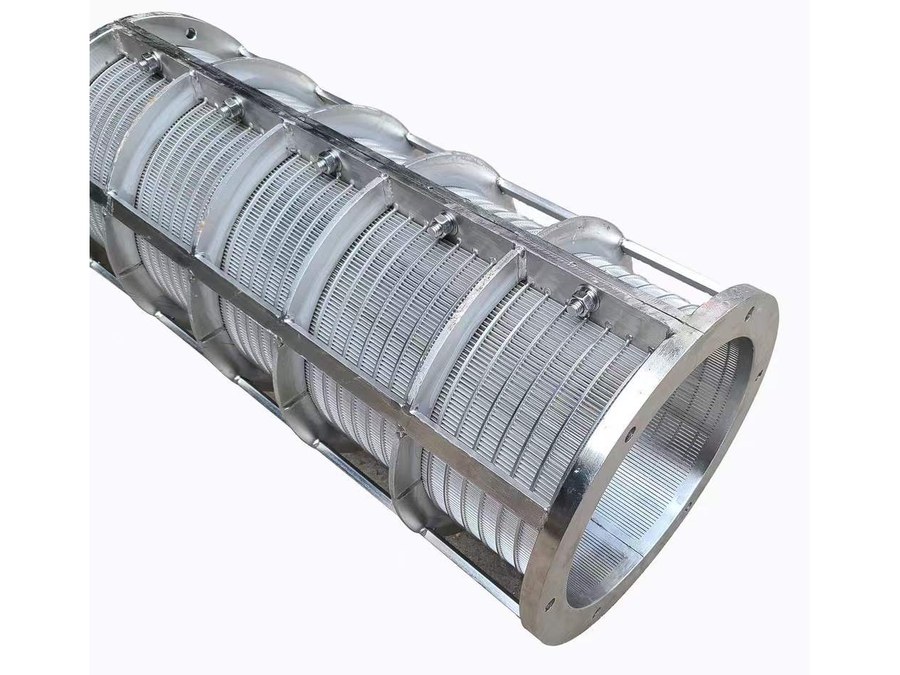
The screening panel inside a pressure-fed curved screen: fine slot held across the arc, V-opening facing the flow so the slot clears itself, and a panel that drops into your existing housing.
Wedge Wire Panels for Pressure Screens
The screening panel inside a pressure-fed curved screen: fine slot held across the arc, V-opening facing the flow so the slot clears itself, and a panel that drops into your existing housing.
| Material | 304 / 316L / 2205 duplex; 0.75x1.5 to 1.5x2.5 mm triangular wire on stainless support rods |
|---|---|
| Size range | Panel width 300-1500 mm, arc 45/60/90/120/180 degrees to machine, slot 0.05-1.0 mm, rod pitch 20-50 mm, framed or unframed, replaceable panel in existing housing |
| Typical application | Starch and glucose slurry screening, paper stock and coating pigment screening, food and beverage process streams, chemical slurry dewatering, CIPC and fibre recovery |
| Cross-section | Square — also drawn to your drawing |
| Surface | Bright drawn, as required |
| Packing | Coil, spool or straight length |
A pressure screen is a sieve bend with the slurry pushed through it. Instead of a gravity feed spreading over the arc, the stock enters a closed housing under pressure, is forced into a thin film against the curve, and separates in the fraction of a second it takes to travel the arc. Everything the panel does in that moment comes down to three things: the slot, the way the wire faces the flow, and how well the panel holds its shape in the housing.
Why the panel is wedge wire and not perforated
At the slots these machines run — 50 to 150 µm in starch, 0.1 to 0.5 mm in paper stock — a drilled or punched plate has two problems. Open area collapses as plate thickness goes up, because every hole is a parallel bore; and the film is thin and fast, so anything that starts to blind blocks a round hole from the inside out. A wedge wire panel gives 10 to 20 percent open area at the same slot, and the opening widens behind the bar face, so a particle that enters has nothing to wedge against. The full comparison with perforated plate is in this article.
Which way the V faces
The wire is triangular, so the slot has a narrow face and a wide side. On a pressure screen the narrow face sits on the flow side and the slot opens away from it. That orientation does two things: it sets the exact cut point at the surface where the film is thinnest, and it stops a fibre or a starch granule from lodging, because the escape route behind it is wider than the entry. Fit the panel the other way up and the screen will blind within a shift — this is the first thing to check when a replacement panel under-performs.
Arc, frame and sealing
Arc angle is a machine dimension, not a preference: 45 and 60 degrees on short screens, 120 to 180 degrees where the housing wraps the flow further round. Panels are supplied to the original arc, framed or unframed, with edge bars dressed so the panel seats flat against the housing gasket. A panel that does not seal at the edges leaks oversize around the screen and the whole separation is lost, which is why the frame drawing matters as much as the slot.
Slot drift is the failure to watch
These screens are usually washed in place and often cleaned with caustic or acid, so the panel lives through thermal and chemical cycling. Slot is checked at several points across the arc when the panel is built, and the same check is what tells you a worn panel has opened up. Panels that have run their life show it first at the discharge end of the arc, where the film is thinnest and the velocity highest.
Specifications
| Panel width | 300–1500 mm, to housing width |
|---|---|
| Arc | 45 / 60 / 90 / 120 / 180 degrees, matched to your machine |
| Slot | 0.05–1.0 mm at the flow face |
| Wire | 0.75×1.5, 1.0×2.0, 1.5×2.5 mm triangular, V-facing flow |
| Support rods | Stainless, 20–50 mm pitch, cross-welded |
| Material | 304 / 316L / 2205 duplex |
| Options | Framed or unframed, reinforced back, drop-in replacement to drawing |
The same screening surface, run under gravity, is on the sieve bend screen page; the wire section is drawn on the triangular wire line. Send the housing drawing or the machine model, the slot you run and the product, and the quote will come back with the arc, frame and wire section we would build for that duty.
Related products
Ready to start your project?
Send us your drawing or sample — we reply within 24 hours on working days.