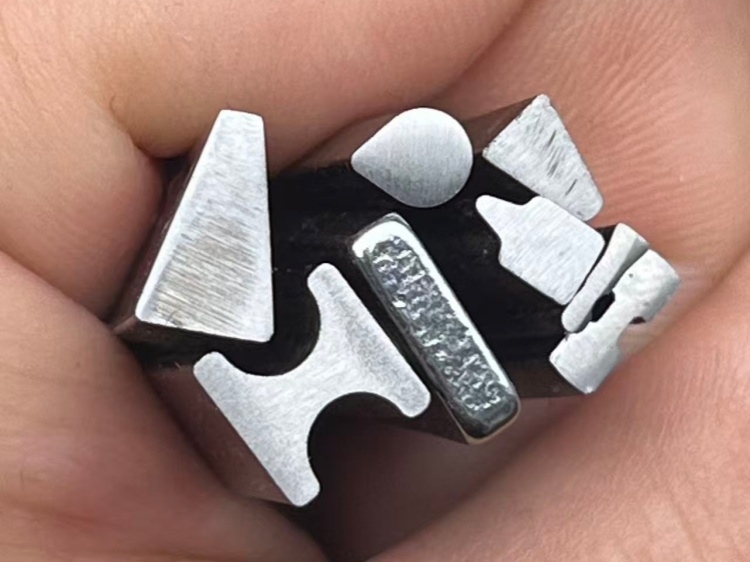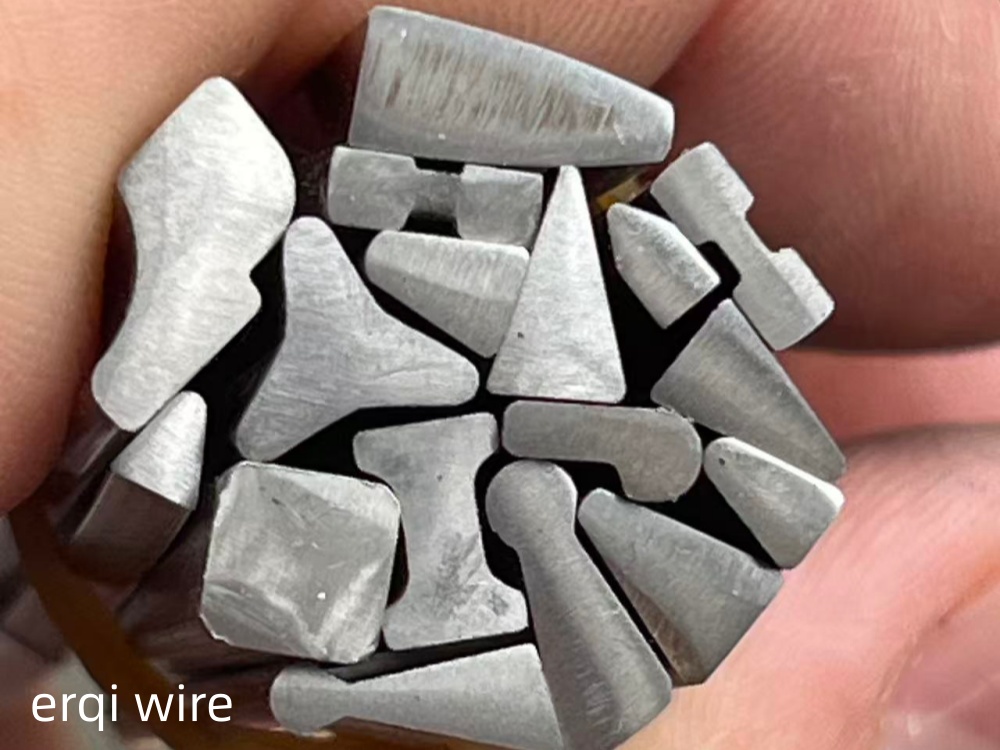
The cross section of a wire determines much more than its appearance. For many industrial products, the profile wire cross section affects contact area, strength, fit, opening size, orientation, and the way the wire is processed. Unlike standard round wire, profile wire is manufactured with a specific cross-sectional shape—simple like flat or rectangular, or specially designed for a particular application. Profile wire cross sections are commonly used in filtration, screening, springs, automotive components, electrical products, and machinery, and when a standard profile does not fit, a custom cross section can be made from a drawing or sample.
A profile wire cross section is the shape you see when a wire is viewed end-on. A standard round wire has a circular cross section; a profile wire has a non-round section designed for a specific function. Common profiles include flat, square, rectangular, triangular, wedge, half-round, trapezoidal, D-shaped, T-shaped, U-shaped, and fully custom or asymmetrical sections. The cross section can be symmetrical or asymmetrical, and may include specific angles, grooves, or corner radii depending on the finished product.
For many applications, the cross section is part of the product design. A different profile changes how the wire contacts another component, how much space it occupies, and how it behaves during forming, welding, bending, or assembly. The profile can influence:
For this reason, selecting profile wire should begin with the requirements of the finished component rather than simply picking a wire from a standard catalog.
A flat cross section is wider than it is thick, providing a relatively large flat surface compared with round wire. It is useful where contact area or limited installation space matters, and is commonly used for springs, clips, retaining components, electrical parts, automotive components, and industrial assemblies. Typical dimensions include width, thickness, edge condition, and corner radius.
A square cross section has four sides of equal nominal width and height. The flat sides provide stable contact and help control orientation during assembly or forming. It is used in springs, mechanical components, tools, fasteners, and industrial assemblies, with corner geometry specified sharp or rounded per material and production needs.
A rectangular profile has different width and height, giving more flexibility than a square section when a component has limited space or a specific dimensional ratio. Applications include springs, rings, electrical components, mechanical and structural parts, and specialized assemblies. For custom rectangular wire, the drawing normally defines width, height, corner radius, and dimensional tolerance.
Triangular wire—also called triangle wire or V-shaped wire—has a three-sided cross section and is widely used in screening and filtration. Its geometry helps create controlled openings between adjacent wires, so it is found in wedge wire screens, well screens, water filtration systems, industrial screening equipment, and separation systems. The wire dimensions and cross-sectional geometry must be matched with the required slot opening and support structure.
Wedge wire has a tapered cross section and is strongly associated with filtration and screening. The profile creates a defined opening when multiple wires are arranged together, and may be welded to support rods to form a rigid screening structure. Typical applications include well screens, water treatment screens, industrial filters, intake screens, separation equipment, and process filtration systems. The cross section should be considered together with slot opening, wire size, support rod arrangement, welding method, and required open area.
A half-round cross section combines a flat side with a curved side—useful when the finished component needs a flat mounting or contact surface while keeping a rounded outer surface. It may be used for guides, reinforcement parts, seals, decorative components, and specialized mechanical applications.
A trapezoidal cross section has four sides with angled geometry, offering a different balance of contact area, available space, and material distribution compared with square or rectangular wire. It may be used in certain mechanical, spring, screening, and industrial applications, with angles and dimensions customized when a standard profile is not suitable.
D-shaped wire combines a flat side with a curved side in a profile resembling the letter "D," useful when a component needs a defined flat contact surface together with a rounded outside surface. It is often considered for seals, guides, mechanical components, retaining parts, and specialized assemblies.
T-shaped and U-shaped profiles are more specialized and may be designed to fit into grooves, channels, tracks, or mating components. Because the geometry is application-specific, these types of profile wire are usually manufactured as custom products based on engineering drawings.
Some applications require a cross section that does not correspond to a standard wire profile—for example an asymmetrical section, a special triangular or modified wedge profile, a grooved wire, a wire with multiple angles, a specific corner radius, a combined flat and curved section, or a completely new geometry. In these cases the wire is designed around the customer's final product, which is particularly useful for OEM manufacturers who can develop the profile directly from the product drawing.
Yes—custom profile wire can be produced according to a technical drawing, sample, or dimensional specification. A typical drawing includes cross-sectional shape, overall width, overall height, angles, corner radii, critical tolerances, material grade, and surface requirements; a sample works when the original drawing is unavailable. For new projects, also provide the final application and expected order quantity.
Cross section and material should be considered together: the profile changes the geometry, while the material affects mechanical and environmental properties.
Stainless steel is widely used for profile wire where corrosion resistance and durability matter, in grades such as 304, 316, and 316L. Typical applications include filtration, water treatment, well screens, chemical equipment, industrial machinery, food processing, and screening systems.
Carbon steel profile wire suits applications where strength and cost are important—springs, mechanical components, structural products, and other industrial uses.
Spring steel is used when the finished component requires repeated elastic deformation and high strength. Flat, square, rectangular, and other cross sections can be produced for specialized spring designs.
Other metals and alloys can be used when the application requires specific conductivity, corrosion resistance, temperature resistance, or mechanical properties. The available material should be confirmed based on the required cross section, dimensions, production process, and quantity.
Filtration is one of the clearest examples of why the wire cross section matters. In a screening structure, adjacent profile wires form openings, and the wire shape influences how those openings are formed and how the final screen surface behaves. Triangular and wedge profiles are commonly used here. Important parameters for a screen manufacturer include wire profile, wire width and height, slot opening, support rod diameter, welding method, open area, screen strength, and material grade—so the wire profile should be selected together with the complete screen design.
In mechanical applications, the cross section may be selected to improve fit, contact, stability, or strength. A flat or rectangular section can provide a larger contact surface than round wire; a square section can help control orientation; a custom section may fit directly into a groove and eliminate a separate machining step. The correct choice depends on the actual component and manufacturing process.
What will the wire become after processing? A screen, spring, electrical component, mechanical part, and decorative product may each require a completely different profile.
Define the overall width and height first, then identify any critical angles, radii, or other dimensions.
For precision applications, tolerance can be just as important as the nominal dimensions.
Consider corrosion resistance, strength, temperature, conductivity, and forming requirements.
The wire may need to be wound, welded, bent, stamped, formed, or assembled after delivery, so the cross section should be compatible with the customer's production process.
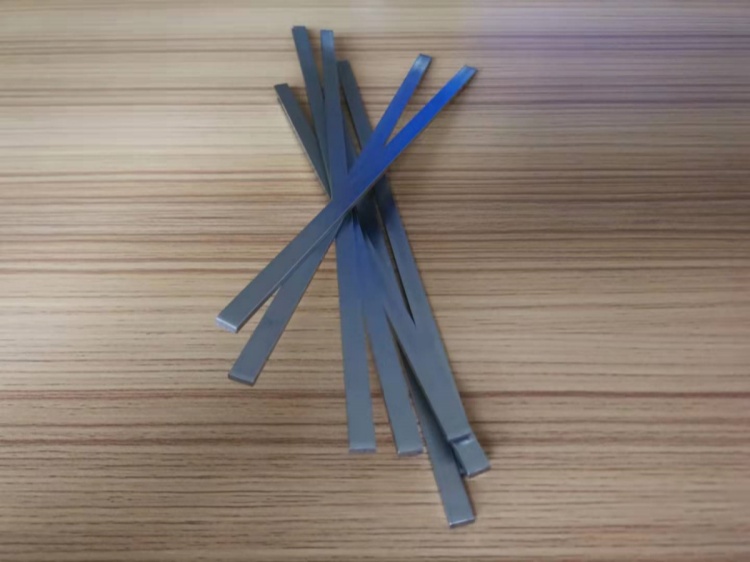
Profile wire can be supplied in coils, spools, or straightened and cut lengths depending on the application.
The production method depends on the material and required geometry, and may involve cold rolling, drawing, profile forming, sizing, straightening, surface finishing, and inspection. Some profiles are produced efficiently through rolling or drawing, while more complicated shapes may require several steps. Dimensional consistency matters throughout—the manufacturer may need to control width, height, corner radius, angles, surface condition, and other critical features.
For round wire, the main dimensional reference is usually its diameter; for profile wire there may be several critical dimensions. A small change in width, height, angle, or radius can affect how the wire fits or performs in the finished product, which is especially important for screening and filtration, precision springs, electrical contacts, grooved components, welding structures, and mechanical assemblies. For custom profile wire, the manufacturer and customer should agree on the critical dimensions and tolerances before production.
It is the shape of the wire when viewed from the end. Unlike round wire, profile wire has a specific non-round geometry designed for a particular application.
Common profiles include flat, square, rectangular, triangular, wedge, half-round, trapezoidal, D-shaped, and various custom sections.
Triangular and wedge profiles are commonly used in screening and filtration products because their geometry can form controlled openings.
Yes. Stainless steel is widely used for profile wire, especially where corrosion resistance is important.
Yes. A custom profile can be manufactured according to a customer's drawing, sample, material specification, dimensions, and tolerance requirements.
A cross-sectional drawing or sample, material grade, dimensions, tolerances, surface requirements, quantity, delivery form, and application details are useful for developing a custom profile wire.
Profile wire cross sections are an important part of industrial wire design. Flat, square, rectangular, triangular, wedge, half-round, trapezoidal, and custom profiles are all used for different purposes, and the right cross section depends on the finished product, material, dimensions, tolerance, manufacturing method, and operating environment. For standard applications an existing profile may be sufficient; for more specialized products, a custom cross section can be developed directly from a drawing or sample.
This article is prepared by the technical team at Hubei ERQI New Materials Co., Ltd. We manufacture stainless profile wire, shaped wire and wedge wire—including triangular, flat, square, rectangular and fully custom sections—in materials such as 304, 316L and 2205 duplex, made to your drawing and tolerance.
Related products:
Email: info@erqiwire.com · Website: erqiwire.com — send us your cross-sectional drawing or sample to discuss a suitable production solution.
Contact: Kevin
Phone: +8613669008985
Whatsapp:+8613669008985
Email: info@erqiwire.com
Address: Xiangyang, Hubei Province, China
Web:erqiwire.com